[ APPLICATIONS & ENGINEERING ]LIVE
Forge™
Ship production software at AI-native speed. Agent swarms turn specifications into working systems — new applications, modernisations, integrations and services-as-software — with human review at the gates that matter, delivered in weeks and priced on fixed outcomes rather than billed hours.
// Problem
The Problem
Enterprise software delivery is priced and paced by headcount, so the estimate is a function of how many people are available rather than how hard the problem is. Modernisation backlogs grow faster than they clear, integration work absorbs teams for quarters, and the projects that would actually differentiate the business queue behind the ones that merely keep it running. The commercial model compounds the problem: billing by hour rewards duration.
- Delivery timelines scale with team size, not with problem difficulty.
- Integration and modernisation work consumes the capacity meant for differentiation.
- Time-and-materials contracts align the vendor's incentive against the client's.
- Specification-to-code handoff loses intent at every translation step.
// Overview
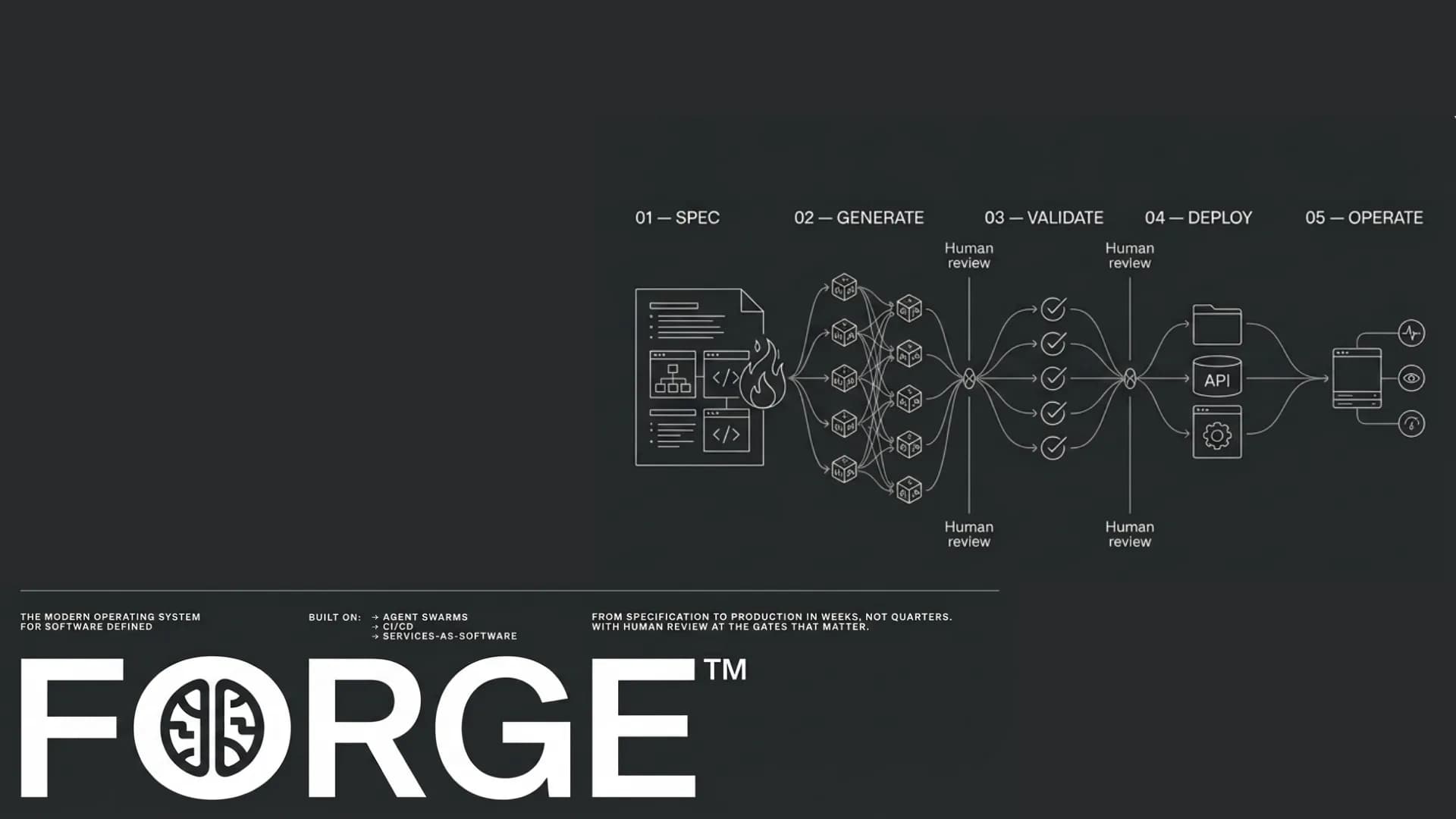
Forge applies agent swarms to the delivery pipeline itself. A specification is decomposed and distributed across coding agents that generate, self-validate and integrate, with human engineers reviewing at defined gates — design, validation, deployment — rather than at every commit. The output is production software running in the client's environment, delivered on a fixed-outcome commercial basis. The same machinery covers greenfield applications, modernisation of existing systems, integration work, and services-as-software where a manual process is replaced by a running system.
// AI System
Why AI
Agent swarms change the economics of delivery because generation, validation and integration can proceed in parallel across a decomposed specification, while human attention concentrates at the points where judgment actually changes the outcome. Reviewing at gates rather than at every commit is the operative choice: it preserves engineering control over architecture and correctness without making a human the throughput limit on typing. That is what makes fixed-outcome pricing viable — the cost is no longer a linear function of duration.
// Specs
Specifications
- SCOPE
- New applications, modernisation, integration, services-as-software
- METHOD
- Agent swarms, spec-decomposed, self-validating
- HUMAN CONTROL
- Review gates at design, validation and deployment
- DELIVERY
- Weeks
- COMMERCIALS
- Fixed outcome, not time and materials
// Features
Features
- 01Specification decomposed and executed in parallel across coding agents.
- 02Self-validation inside the loop, so review receives working code rather than drafts.
- 03Human engineering review concentrated at design, validation and deployment gates.
- 04Covers modernisation and integration, not only greenfield builds.
- 05Services-as-software: manual processes replaced by running systems, not by documentation.
- 06Priced on delivered outcome, aligning vendor incentive with client timeline.
// Architecture
Architecture
DELIVERY FLOW
Runtime · one item, left to right
- 01Specification
- 02Decomposition
- 03Agent Swarm: Generate + ValidateApplicationModernisationIntegrationServices-as-Software
- 04Integration
- 05Human Review Gate
- 06Production Deploy
dashed = the inference step, where the system exercises judgment
System stack
Data in · decisions out
01
Sources
Specs, code, and the legacy estate
02
Ingestion
Understand before generating
03
Ontology
Delivery as traceable objects
04AI
Intelligence
Agents build, gates verify
05Human
Human control
Gates are the control surface
06
Actions
Written back
Observability
Every model call traced; evals run on real cases, not anecdotes.
Governance
Entitlements enforced at retrieval; rules versioned by the organisation.
Write-back
Systems of record are written only through the approval gate.
Gates are the control surface — architecture and correctness stay under human engineering authority.
// Impact
Impact
- Weeks
- Delivery, against quartersindicative target
- Fixed
- Commercial basis, not hourlyverified
Interested in Forge?
Let's take a specification you've been holding and scope it.
Get in touch