[ PHYSICAL AI OPERATIONS ]LIVE
Motion™
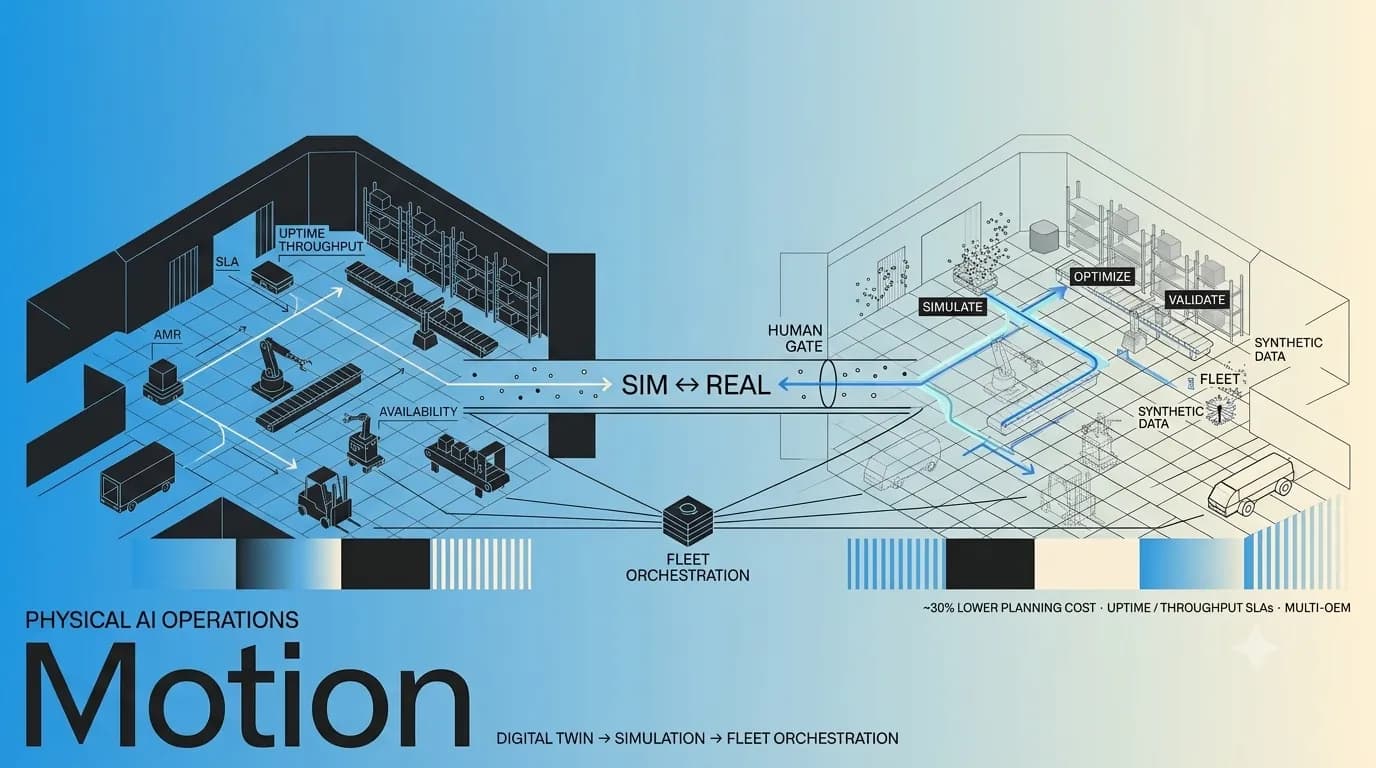
Operate the physical world on uptime SLAs. Digital twins, simulation and synthetic data, and multi-OEM robotic fleet orchestration run physical operations as a managed outcome — with value captured in software and fleet management rather than hardware, and physical actions human-gated.
// Problem
The Problem
Physical operations are planned with tools that cannot simulate the plan. Layout, throughput and fleet-sizing decisions are made in spreadsheets and validated only after capital is committed, so mistakes are discovered in concrete. Robotics compounds this: fleets from different vendors arrive with incompatible control stacks, so an operator with three OEMs runs three consoles and has no unified view of availability or throughput.
- Planning decisions are validated after commitment, when they are expensive to reverse.
- Multi-OEM fleets fragment into separate control stacks with no common availability picture.
- Training perception models requires edge-case data that real operations rarely produce safely.
- Vendors sell hardware and disclaim the outcome, so uptime is nobody's contractual problem.
// Overview
Motion runs physical operations against a live digital twin. Layout, routing and fleet-sizing decisions are simulated before commitment, and the twin remains synchronised with the floor in operation, so deviation is visible against plan rather than discovered at the end of a shift. Synthetic data generation supplies the edge cases that perception models need and real operations cannot safely produce. Fleet orchestration is multi-OEM by design, presenting one availability and throughput picture across heterogeneous robots. Physical actions are human-gated; the commercial model is SLA-backed on uptime and throughput.
// AI System
Why AI
Simulation and synthetic data address the fundamental constraint of physical AI: you cannot collect enough real-world failure data safely, and you cannot iterate on a floor plan that has already been built. Training in a twin and transferring to the real system inverts the order — the expensive decision is tested before it is made. Orchestration across OEMs is a planning problem over heterogeneous capability, which is exactly where a model outperforms a per-vendor scheduler.
// Specs
Specifications
- TWIN
- Live digital twin, synchronised with floor state
- SIMULATION
- Layout, routing and fleet-sizing tested pre-commitment
- DATA
- Synthetic generation for perception edge cases
- FLEET
- Multi-OEM orchestration under one availability view
- SAFETY
- Physical actions human-gated
- COMMERCIALS
- SLA-backed on uptime and throughput
// Features
Features
- 01Capital decisions simulated in the twin before commitment, not validated after.
- 02Twin stays synchronised in operation, so deviation from plan is visible live.
- 03Synthetic data supplies perception edge cases real operations cannot safely produce.
- 04One availability and throughput view across robots from different vendors.
- 05Physical actions gated by human authorisation at defined boundaries.
- 06Contracted on uptime and throughput, so the outcome is the vendor's problem.
// Architecture
Architecture
SIM-TO-REAL FLOW
Runtime · one item, left to right
- 01Floor Telemetry
- 02Digital Twin Sync
- 03Simulation + PlanningLayoutRoutingFleet SizingSynthetic Data
- 04Fleet Orchestration
- 05Human Safety Gate
- 06Physical Execution
dashed = the inference step, where the system exercises judgment
System stack
Data in · decisions out
01
Sources
The physical floor
02
Ingestion
Twin in sync
03
Ontology
The floor as objects
04AI
Intelligence
Simulate, then act
05Human
Human control
Operations approve the change
06
Actions
Written back
Observability
Every model call traced; evals run on real cases, not anecdotes.
Governance
Entitlements enforced at retrieval; rules versioned by the organisation.
Write-back
Systems of record are written only through the approval gate.
Execution telemetry returns to the twin; the loop closes at the floor.
// Impact
Impact
- ~30%
- Lower planning costindicative target
- SLA-backed
- Robot availabilitycommercial commitment
Interested in Motion?
Let's twin your floor before you commit the capital.
Get in touch